Overview
The Bureau of Internal Revenue (BIR) has formally resumed the issuance of Letters of Authority (LOAs) and the conduct of field tax audits as of January 2026, following the temporary suspension and review period initiated in late 2025.
This restart reflects the government’s continued commitment to revenue protection, now supported by procedural reforms intended to strengthen audit integrity, transparency, and accountability.
For micro and small enterprises (MSEs), this development is best viewed not as a disruption, but as an opportunity:
to build stronger business foundations, improve documentation discipline, and enhance long-term sustainability.
At Optimum Business Solutions, our advocacy is clear:
empowered MSMEs are compliant MSMEs—and compliant MSMEs are resilient and investor-ready.
What is a Letter of Authority (LOA)?
A Letter of Authority (LOA) is the formal document issued by the BIR authorizing revenue officers to examine a taxpayer’s books of accounts and supporting documents for compliance verification.
A LOA audit may cover:
- Income tax declarations
- VAT or percentage tax compliance
- Withholding tax obligations
- Substantiation of deductions and operating expenses
- Alignment between filed returns and accounting records
Confirmed Update: BIR Has Lifted the Audit Suspension
Finance and revenue authorities have confirmed that the suspension on LOAs and field audit operations has been lifted, with audits now proceeding under an improved framework.
Importantly, the resumption has been accompanied by reforms designed to reduce redundancy and strengthen safeguards for taxpayers.
This reflects an evolving audit environment—one where small businesses benefit most when they are prepared, organized, and properly guided.
Key Audit Reforms Introduced
Micro and small enterprises should take note of the following structural changes:
- One LOA Per Taxable Year Taxpayers will generally be subject to one LOA per taxable year, reducing overlapping examinations and providing clearer audit coverage.
- Consolidated and More Structured Audits Multiple audit issuances will be consolidated, promoting consistency and reducing repetitive requests.
- Improved Oversight and Accountability The BIR has undertaken internal restructuring, including disbanding certain audit task forces, to strengthen governance within the audit system.
- Digital LOA Verification Taxpayers may verify LOA authenticity through the BIR’s chatbot tool, REVIE, promoting transparency and taxpayer protection.
These reforms signal that audits are returning in a more disciplined and verification-based manner.
Key Takeaways for MSMEs (Optimum Advisory)
- Tax audits and LOA issuances have officially resumed in 2026.
- MSMEs should approach this development with preparation—not apprehension.
- Compliance readiness is a business strength that supports growth, credibility, and sustainability.
- VAT, withholding taxes, and expense documentation remain key review areas.
- The “one LOA per year” framework provides greater predictability but may lead to more comprehensive examinations.
- Proactive compliance is significantly more cost-effective than reactive deficiency assessments.
Why MSME Empowerment Matters in This Environment
Micro and small enterprises are the backbone of the Philippine economy.
However, many MSMEs face compliance challenges not due to intent, but due to:
- limited administrative resources
- informal documentation habits
- lack of technical support
- operational focus on day-to-day survival
The return of audits underscores the need to strengthen MSME capacity—not to penalize, but to empower.
When MSMEs adopt sound compliance systems, they become more resilient, bankable, and scalable.
Who May Benefit Most from Early Preparation?
MSMEs in the following categories are encouraged to strengthen readiness:
- Retail and trading businesses with high-volume invoicing
- Service providers claiming professional fees and operating expenses
- VAT-registered enterprises with significant input VAT
- Businesses with mixed withholding tax obligations
- Companies transitioning from manual to formal bookkeeping systems
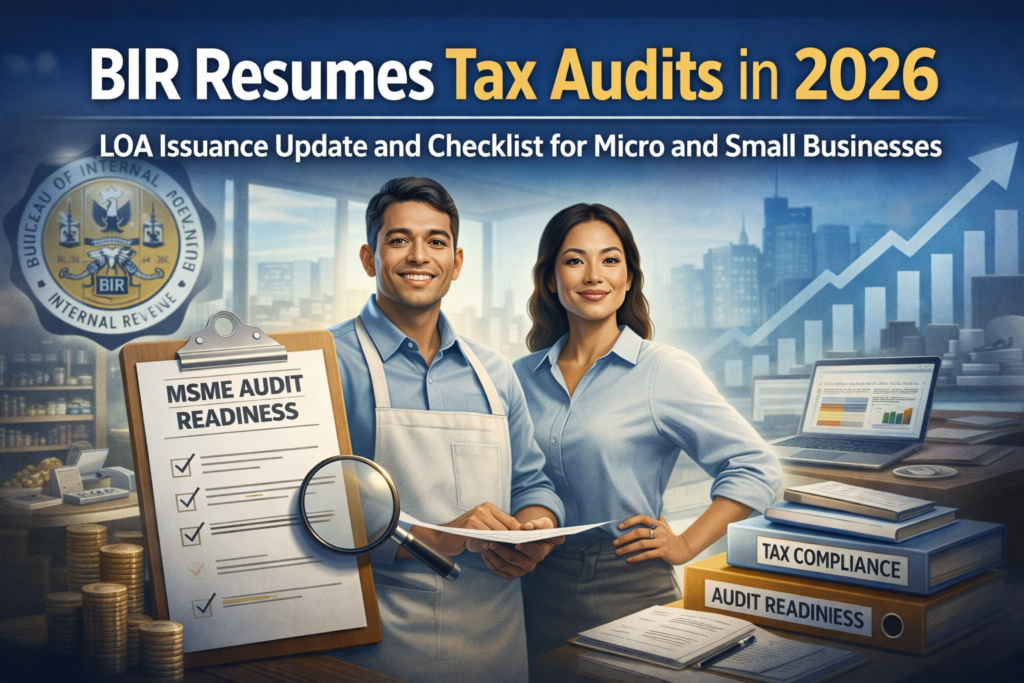
MSME Audit Readiness Checklist (2026 Edition)
Optimum encourages MSMEs to take practical, confidence-building steps:
These measures do not merely reduce audit risk—they enhance overall business governance.
Frequently Asked Questions (MSME-Friendly)
Can small businesses be audited?
Yes. MSMEs may receive LOAs, especially when inconsistencies arise in filings or documentation.
Does audit resumption mean stricter enforcement?
Audits are returning under a more structured framework. Prepared businesses will be in a stronger position.
What is the best MSME approach?
Stay proactive, organized, and guided. Audit readiness should be part of business maturity.
Conclusion: Compliance as a Tool for MSME Growth
The resumption of LOA issuance and tax audits in 2026 marks a renewed enforcement environment, now supported by reforms and verification safeguards.
For micro and small enterprises, the path forward is clear:
Compliance is not a burden—it is empowerment.
It enables businesses to grow responsibly, attract opportunities, and operate with confidence.
How Optimum Business Solutions Supports MSMEs
Optimum is committed to empowering MSMEs through:
- Tax compliance diagnostics and filing support
- Audit readiness assessments and documentation strengthening
- VAT and withholding tax advisory
- BIR audit assistance and procedural guidance
- Bookkeeping systems and monthly closing support
- Internal controls and governance improvement for growing enterprises
Coordinate with Optimum Business Solutions to strengthen your business readiness and resilience in 2026.